
 ,
Jeanne Senam Aklamanu,
Alphonse Déssoudji Gboglo,
Ognanmi Ako,
Abdoul-Razak Ali-Tagba,
Monneka Fiacre Kouide,
Danoka Djagbai,
Makadatièna Badjemna,
Akotchayé Amenou
,
Jeanne Senam Aklamanu,
Alphonse Déssoudji Gboglo,
Ognanmi Ako,
Abdoul-Razak Ali-Tagba,
Monneka Fiacre Kouide,
Danoka Djagbai,
Makadatièna Badjemna,
Akotchayé Amenou
The present study investigates the influence of growth time on the physical properties of ZnO thin films grown by the hydrothermal method. Film fabrication is carried out via a two-step process involving the deposition of ZnO seed layers on glass substrates by spin coating, followed by hydrothermal growth. Post-deposition annealing at 400°C for 3 hours is performed to enhance crystallinity. Structural and optical properties are analyzed using X-ray diffraction (XRD), UV–visible spectroscopy, and photoluminescence (PL) spectroscopy. XRD results confirm that all films are polycrystalline with a hexagonal wurtzite structure and exhibit a pronounced preferential orientation along the (002) plane. The progressive increase in the (002) peak intensity with growth time indicates enhanced crystalline quality, accompanied by an increase in crystallite size from 11.19 to 14.67 nm. UV–visible analysis shows that transmittance decreases from 95% to 65% with increasing growth time, mainly due to increased film thickness and density. However, films grown between 2 and 5 hours provide a good compromise between high transmittance in the visible region and strong absorption in the ultraviolet region. The optical bandgap varies from 3.14 eV to 3.27 eV, attributed to changes in film thickness. PL spectra exhibit three emission bands centered at 412 nm (3.01 eV), 438 nm (2.83 eV), and 490 nm (2.53 eV), associated with intrinsic defects in ZnO. The films grown for 4 hours exhibit relatively low defect density and good visible transmittance, making them promising candidates for photovoltaic applications.
| Published in | Advances in Materials (Volume 15, Issue 3) |
| DOI | 10.11648/j.am.20261503.13 |
| Page(s) | 99-109 |
| Creative Commons |
This is an Open Access article, distributed under the terms of the Creative Commons Attribution 4.0 International License (http://creativecommons.org/licenses/by/4.0/), which permits unrestricted use, distribution and reproduction in any medium or format, provided the original work is properly cited. |
| Copyright |
Copyright © The Author(s), 2026. Published by Science Publishing Group |
Thin Film, Zinc Oxide, Growth Time, Physical Properties, Hydrothermal, Photovoltaic Applications
(hkl) | Growth time | JCPDS card 36-1451 | |||||
|---|---|---|---|---|---|---|---|
1 h | 2 h | 3 h | 4 h | 5 h | 6 h | ||
(100) | 31.645 | 31.677 | 31.617 | 31.546 | 31.539 | 31.574 | 31.770 |
(002) | 34.238 | 34.268 | 34.297 | 34.331 | 34.331 | 34.325 | 34.422 |
(101) | 36.108 | 36.518 | 36.458 | 36.282 | 36.303 | 36.588 | 36.253 |
Growth time | TC(hkl) | ||
|---|---|---|---|
(100) | (002) | (101) | |
1 h | 0.4 | 2.0 | 0.5 |
2 h | 0.7 | 2.1 | 0.3 |
3 h | 0.6 | 2.2 | 0.3 |
4 h | 0.5 | 2.3 | 0.3 |
5 h | 0.3 | 2.4 | 0.3 |
6 h | 0.3 | 2.6 | 0.2 |
Growth time | Lattice parameters | (Å) | (°) | D (nm) | (1014 lines/m2) |
| V | L (Å) | ||
|---|---|---|---|---|---|---|---|---|---|---|
a (Å) | c (Å) | c/a | ||||||||
1 h | 3.262 | 5.234 | 1.604 | 2.616 | 0.742 | 11.192 | 79.831 | 10.496 | 48.328 | 1.987 |
2 h | 3.260 | 5.229 | 1.605 | 2.614 | 0.736 | 11.290 | 78.443 | 10.421 | 48.235 | 1.986 |
3 h | 3.265 | 5.225 | 1.600 | 2.612 | 0.643 | 12.911 | 59.987 | 9.105 | 48.237 | 1.986 |
4 h | 3.272 | 5.220 | 1.595 | 2.610 | 0.649 | 12.795 | 61.074 | 9.179 | 48.403 | 1.988 |
5 h | 3.273 | 5.223 | 1.596 | 2.611 | 0.649 | 12.808 | 60.958 | 9.175 | 48.450 | 1.989 |
6 h | 3.261 | 5.221 | 1.597 | 2.610 | 0.566 | 14.672 | 46.448 | 8.019 | 48.100 | 1.984 |
JCPDS card 36-1451 | 3.250 | 5.207 | 1.602 | 2.603 | - | - | - | 47.622 | - | |
Growth time | Band gap energy (eV) |
|---|---|
1 h | 3.27 |
2 h | 3.18 |
3 h | 3.20 |
4 h | 3.15 |
5 h | 3.16 |
6 h | 3.14 |
ZnO | Zinc Oxide |
TiO2 | Titanium Dioxide |
HMTA | Hexamethylenetetramine |
FWHM | Full Width at Half Maximum |
XRD | X-ray Diffraction |
UV | Ultraviolet |
UV-Vis | Ultraviolet-visible Spectroscopy |
PL | Photoluminescence |
NBE | Near-Band-Edge |
SEM | Scanning Electron Microscopy |
AFM | Atomic Force Microscopy |
JCPDS | Joint Committee on Powder Diffraction Standards |
CERME | Centre d’Excellence Régional Pour la Maîtrise de l’Electricité |
| [1] | A. Ejsmont, J. Goscianska, Hydrothermal Synthesis of ZnO Superstructures with Controlled Morphology via Temperature and pH Optimization, Materials 16 (2023) 1641. |
| [2] | P. Dhanasekaran, R. Marimuthu, A Review on Dye-Sensitized Solar Cells (DSSCs), Materials and Applications, Iran. J. Mater. Sci. Eng. 20 (2023). |
| [3] | A. Taleb, F. Mesguich, A. Hérissan, C. Colbeau-Justin, X. Yanpeng, P. Dubot, Optimized TiO2 nanoparticle packing for DSSC photovoltaic applications, Sol. Energy Mater. Sol. Cells 148 (2016) 52–59. |
| [4] | M. Z. Hossain, S. M. A. Nayem, S. Alam, I. Islam, G. Seong, A.-N. Chowdhury, Hydrothermal ZnO Nanomaterials: Tailored Properties and Infinite Possibilities, Nanomaterials 15 (2025) 609. |
| [5] | A. D. Gboglo, M. Baneto, O. Ako, A.-R. Ali-Tagba, B. Grandidier, K. N’konou, Combined Influence of Precursor Source and Solvent Type on Microstructural and Optical Properties of Spin-Coated ZnO Thin Films, Surfaces 9 (2026) 50. |
| [6] | N. Zhang, K. Yu, L. Li, Z. Zhu, Investigation of electrical and ammonia sensing characteristics of Schottky barrier diode based on a single ultra-long ZnO nanorod, Appl. Surf. Sci. 254(2008): 5736–5740. |
| [7] | F. T. Z. Toma, M. S. Rahman, K. H. Maria, A review of recent advances in ZnO nanostructured thin films by various deposition techniques, Discov. Mater. 5 (2025) 60. |
| [8] | P. Sigmund, Theory of Sputtering. I. Sputtering Yield of Amorphous and Polycrystalline Targets, Phys. Rev. 184 (1969) 383–416. |
| [9] | J. L. H. Chau, M.-C. Yang, T. Nakamura, S. Sato, C.-C. Yang, C.-W. Cheng, Fabrication of ZnO thin films by femtosecond pulsed laser deposition, Opt. Laser Technol. 42 (2010) 1337–1339. |
| [10] | S. Faÿ, U. Kroll, C. Bucher, E. Vallat-Sauvain, A. Shah, Low pressure chemical vapour deposition of ZnO layers for thin-film solar cells: temperature-induced morphological changes, Sol. Energy Mater. Sol. Cells 86 (2005) 385–397. |
| [11] | E. Heredia, C. Bojorge, J. Casanova, H. Cánepa, A. Craievich, G. Kellermann, Nanostructured ZnO thin films prepared by sol–gel spin-coating, Appl. Surf. Sci. 317 (2014) 19–25. |
| [12] | O. Ako, M. Baneto, A. D. Gboglo, M. Senthilkumar, M. Haris, Temperature-controlled growth of ZnO Thin films by spray pyrolysis: Influence on physical properties for photovoltaic applications, Edelweiss Appl. Sci. Technol. 9 (2025) 1052–1066. |
| [13] | A. D. Gboglo, M. Baneto, O. Ako, K. S. Gadedjisso-Tossou, B. Grandidier, M. Haris, M. Senthilkumar, K. N’Konou, Structural, morphological and optical properties of ZnO thin films grown by time-dependent chemical bath deposition, Int. J. Renew. Energy Dev. 15 (2026) 66–75. |
| [14] | D. Polsongkram, P. Chamninok, S. Pukird, L. Chow, O. Lupan, G. Chai, H. Khallaf, S. Park, A. Schulte, Effect of synthesis conditions on the growth of ZnO nanorods via hydrothermal method, Phys. B Condens. Matter 403 (2008) 3713–3717. |
| [15] | H. S. Wasly, M. S. A. El-Sadek, M. Henini, Influence of Reaction Time and Synthesis Temperature on Physical Properties of ZnO Nanoparticles Synthesized by Hydrothermal Method, Appl. Phys. A 124 (2018). |
| [16] | M. M. Kareem, Z. T. Khodair, F. Y. Mohammed, Effect of annealing temperature on structural, morphological and optical properties of zno nanorod thin films prepared by hydrothermal method, J. Ovonic Res. 16 (2020) 53–61. |
| [17] | Y. T. Yin, W. X. Que, C. H. Kam, ZnO nanorods on ZnO seed layer derived by sol–gel process, J. Sol-Gel Sci. Technol. 53 (2010) 605–612. |
| [18] | A. Dloo, N. Fazouan, E. H. Atmani, Investigation of hydrothermal growth time and temperature for optimized ZnO nanowire arrays toward photovoltaics, Surf. Interfaces 40 (2023) 103123. |
| [19] | G. Amin, M. H. Asif, A. Zainelabdin, S. Zaman, O. Nur, M. Willander, Influence of pH, Precursor Concentration, Growth Time, and Temperature on the Morphology of ZnO Nanostructures Grown by the Hydrothermal Method, J. Nanomater. 2011 (2011) 1–9. |
| [20] | E. M. Abdel-Fattah, S. M. Alshehri, Effect of Hydrothermal Reaction Time on the Morphological and Photocatalytic Properties of ZnO Nanostructures, Appl. Sci. 16 (2026) 1408. |
| [21] | S. Abou Zeid, A. Perez, S. Bastide, S. Rossano, Y. Leprince-Wang, Time-Dependent Growth of ZnO Nanowires: Unveiling Antibacterial and Photocatalytic Properties, Langmuir 41 (2025) 2237–2247. |
| [22] | H. Ebrahimi, H. Yaghoubi, F. Giammattei, A. Takshi, Electrochemical Detection of Piezoelectric Effect from Misaligned Zinc Oxide Nanowires Grown on a Flexible Electrode, Electrochimica Acta 134 (2014) 435–441. |
| [23] | R. Rai, T. Triloki, B. K. Singh, X-ray diffraction line profile analysis of KBr thin films, Appl. Phys. A 122 (2016) 774. |
| [24] | M. Baneto, D. Djagbai, E. Mouzou, A. D. Gboglo, O. Ako, M. F. Kouide, D. Kassegne, Controlled Deposition of Zn Thin Films by Spin Coating: Influence of Spin Speed on Film Microstructure and Transparency, J. Nano- Electron. Phys. 17 (2025) 05016-1-05016–8. |
| [25] | G. K. Williamson, R. E. Smallman, III. Dislocation densities in some annealed and cold-worked metals from measurements on the X-ray debye-scherrer spectrum, Philos. Mag. 1 (1956) 34–46. |
| [26] | H. F. McMurdie, M. C. Morris, E. H. Evans, B. Paretzkin, W. Wong-Ng, L. Ettlinger, C. R. Hubbard, Standard X-Ray Diffraction Powder Patterns from the JCPDS Research Associateship, Powder Diffr. 1 (1986) 64–77. |
| [27] | A. D. Gboglo, M. Baneto, O. Ako, M. Haris, M. Senthilkuma, Role of hexamethylenetetramine/zinc nitrate hexahydrate molar ratio in controlling structural, morphological and optical properties of ZnO thin films synthesized by CBD, AIMS Mater. Sci. 12 (2025) 893–908. |
| [28] | O. Ako, M. Baneto, M. Senthilkumar, M. Haris, A. D. Gboglo, K. S. Gadedjisso-Tossou, A. C. Ahyi, K. Beltako, K. A. Amou, Simultaneous effect of precursor sources and concentration on structural, morphological and optical properties of ZnO nanostructured thin films for photovoltaic applications, Int. J. Renew. Energy Dev. 14 (2025) 495–504. |
| [29] | P. Obreja, D. Cristea, A. Dinescu, C. Romaniţan, Influence of surface substrates on the properties of ZnO nanowires synthesized by hydrothermal method, Appl. Surf. Sci. 463 (2019) 1117–1123. |
| [30] | A. M. Alsaad, A. A. Ahmad, Q. M. Al-Bataineh, A. A. Bani-Salameh, H. S. Abdullah, I. A. Qattan, Z. M. Albataineh, A. D. Telfah, Optical, Structural, and Crystal Defects Characterizations of Dip Synthesized (Fe-Ni) Co-Doped ZnO Thin Films, Materials 13 (2020) 1737. |
| [31] | M. Arellano-Cortaza, E. Ramírez-Morales, U. Pal, G. Pérez-Hernández, L. Rojas-Blanco, pH dependent morphology and texture evolution of ZnO nanoparticles fabricated by microwave-assisted chemical synthesis and their photocatalytic dye degradation activities, Ceram. Int. 47(2021): 27469–27478. |
| [32] | M. N. Kamalasanan, S. Chandra, Sol-gel synthesis of ZnO thin films, Thin Solid Films 288(1996): 112–115. |
| [33] | A. F. Abdulrahman, S. M. Ahmed, N. M. Ahmed, M. A. Almessiere, Enhancement of ZnO Nanorods Properties Using Modified Chemical Bath Deposition Method: Effect of Precursor Concentration, Crystals 10 (2020) 386. |
| [34] | L. M. Balcazar, M. D. L. L. Olvera Amador, IGZO thin films deposited by ultrasonic spray pyrolysis: effect of Zn precursor milling and In and Ga concentration, J. Mater. Sci. Mater. Electron. 35 (2024) 829. |
| [35] | N. Siregar, M. Motlan, M. Sirait, Electroplated ZnO Thin Film: Influence of Deposition Time on Optical and Structural Properties, J. Phys. Sci. 34 (2023) 43–55. |
| [36] | A. D. Gboglo, M. Baneto, K. S. Gadedjisso-Tossou, O. Ako, A. C. Ahyi, M. Haris, M. Senthilkumar, K. N’konou, B. Grandidier, K. Beltako, K. A. Amou, M. M. Dzagli, Co-Effect of pH Control Agent and pH Value on the Physical Properties of ZnO Thin Films Obtained by Chemical Bath Deposition for Potential Application in Dye-Sensitized Solar Cells, Surfaces 8 (2025) 46. |
| [37] | V. Khranovskyy, T. Ekblad, R. Yakimova, L. Hultman, Surface morphology effects on the light-controlled wettability of ZnO nanostructures, Appl. Surf. Sci. 258 (2012) 8146–8152. |
| [38] | D. Sengupta, P. Das, U. Kasinadhuni, B. Mondal, K. Mukherjee, Morphology induced light scattering by zinc oxide polydisperse particles: Promising for dye sensitized solar cell application, J. Renew. Sustain. Energy 6 (2014) 063114. |
| [39] | E. Musavi, M. Khanlary, Z. Khakpour, Red-orange photoluminescence emission of sol-gel dip-coated prepared ZnO and ZnO: Al nano-crystalline films, J. Lumin. (2019). |
| [40] | Y. Li, L. Xu, X. Li, X. Shen, A. Wang, Effect of aging time of ZnO sol on the structural and optical properties of ZnO thin films prepared by sol–gel method, Appl. Surf. Sci. 256 (2010) 4543–4547. |
| [41] | A. Galdámez-Martinez, G. Santana, F. Güell, P. R. Martínez-Alanis, A. Dutt, Photoluminescence of ZnO Nanowires: A Review, Nanomaterials 10 (2020) 857. |
| [42] | J. Li, D. Yang, X. Zhu, Effects of aging time and annealing temperature on structural and optical properties of sol-gel ZnO thin films, AIP Adv. 7 (2017) 065213. |
| [43] | E. A. Araújo Júnior, F. X. Nobre, G. D. S. Sousa, L. S. Cavalcante, M. Rita De Morais Chaves Santos, F. L. Souza, J. M. Elias De Matos, Synthesis, growth mechanism, optical properties and catalytic activity of ZnO microcrystals obtained via hydrothermal processing, RSC Adv. 7(2017): 24263–24281. |
| [44] | L. Xu, X. Wang, L. Qian, Y. Zhu, X. Luo, W. Wang, X. Xu, J. Xu, The dependence of the optical properties of ZnO nanorod arrays on their growth time, Optik 202 (2020) 163634. |
| [45] | R. Marotti, Bandgap energy tuning of electrochemically grown ZnO thin films by thickness and electrodeposition potential, Sol. Energy Mater. Sol. Cells 82 (2004) 85–103. |
| [46] | K. L. Foo, U. Hashim, K. Muhammad, C. H. Voon, Sol–gel synthesized zinc oxide nanorods and their structural and optical investigation for optoelectronic application, Nanoscale Res. Lett. 9(2014): 429. |
APA Style
Baneto, M., Aklamanu, J. S., Gboglo, A. D., Ako, O., Ali-Tagba, A., et al. (2026). Growth Time-dependent Structural and Optical Properties of Hydrothermally Synthesized ZnO Thin Films. Advances in Materials, 15(3), 99-109. https://doi.org/10.11648/j.am.20261503.13
ACS Style
Baneto, M.; Aklamanu, J. S.; Gboglo, A. D.; Ako, O.; Ali-Tagba, A., et al. Growth Time-dependent Structural and Optical Properties of Hydrothermally Synthesized ZnO Thin Films. Adv. Mater. 2026, 15(3), 99-109. doi: 10.11648/j.am.20261503.13
@article{10.11648/j.am.20261503.13,
  author = {Mazabalo Baneto and Jeanne Senam Aklamanu and Alphonse Déssoudji Gboglo and Ognanmi Ako and Abdoul-Razak Ali-Tagba and Monneka Fiacre Kouide and Danoka Djagbai and Makadatièna Badjemna and Akotchayé Amenou},
  title = {Growth Time-dependent Structural and Optical Properties of Hydrothermally Synthesized ZnO Thin Films},
  journal = {Advances in Materials},
  volume = {15},
  number = {3},
  pages = {99-109},
  doi = {10.11648/j.am.20261503.13},
  url = {https://doi.org/10.11648/j.am.20261503.13},
  eprint = {https://article.sciencepublishinggroup.com/pdf/10.11648.j.am.20261503.13},
  abstract = {The present study investigates the influence of growth time on the physical properties of ZnO thin films grown by the hydrothermal method. Film fabrication is carried out via a two-step process involving the deposition of ZnO seed layers on glass substrates by spin coating, followed by hydrothermal growth. Post-deposition annealing at 400°C for 3 hours is performed to enhance crystallinity. Structural and optical properties are analyzed using X-ray diffraction (XRD), UV–visible spectroscopy, and photoluminescence (PL) spectroscopy. XRD results confirm that all films are polycrystalline with a hexagonal wurtzite structure and exhibit a pronounced preferential orientation along the (002) plane. The progressive increase in the (002) peak intensity with growth time indicates enhanced crystalline quality, accompanied by an increase in crystallite size from 11.19 to 14.67 nm. UV–visible analysis shows that transmittance decreases from 95% to 65% with increasing growth time, mainly due to increased film thickness and density. However, films grown between 2 and 5 hours provide a good compromise between high transmittance in the visible region and strong absorption in the ultraviolet region. The optical bandgap varies from 3.14 eV to 3.27 eV, attributed to changes in film thickness. PL spectra exhibit three emission bands centered at 412 nm (3.01 eV), 438 nm (2.83 eV), and 490 nm (2.53 eV), associated with intrinsic defects in ZnO. The films grown for 4 hours exhibit relatively low defect density and good visible transmittance, making them promising candidates for photovoltaic applications.},
 year = {2026}
}
TY  - JOUR
T1  - Growth Time-dependent Structural and Optical Properties of Hydrothermally Synthesized ZnO Thin Films
AU  - Mazabalo Baneto
AU  - Jeanne Senam Aklamanu
AU  - Alphonse Déssoudji Gboglo
AU  - Ognanmi Ako
AU  - Abdoul-Razak Ali-Tagba
AU  - Monneka Fiacre Kouide
AU  - Danoka Djagbai
AU  - Makadatièna Badjemna
AU  - Akotchayé Amenou
Y1  - 2026/08/18
PY  - 2026
N1  - https://doi.org/10.11648/j.am.20261503.13
DO  - 10.11648/j.am.20261503.13
T2  - Advances in Materials
JF  - Advances in Materials
JO  - Advances in Materials
SP  - 99
EP  - 109
PB  - Science Publishing Group
SN  - 2327-252X
UR  - https://doi.org/10.11648/j.am.20261503.13
AB  - The present study investigates the influence of growth time on the physical properties of ZnO thin films grown by the hydrothermal method. Film fabrication is carried out via a two-step process involving the deposition of ZnO seed layers on glass substrates by spin coating, followed by hydrothermal growth. Post-deposition annealing at 400°C for 3 hours is performed to enhance crystallinity. Structural and optical properties are analyzed using X-ray diffraction (XRD), UV–visible spectroscopy, and photoluminescence (PL) spectroscopy. XRD results confirm that all films are polycrystalline with a hexagonal wurtzite structure and exhibit a pronounced preferential orientation along the (002) plane. The progressive increase in the (002) peak intensity with growth time indicates enhanced crystalline quality, accompanied by an increase in crystallite size from 11.19 to 14.67 nm. UV–visible analysis shows that transmittance decreases from 95% to 65% with increasing growth time, mainly due to increased film thickness and density. However, films grown between 2 and 5 hours provide a good compromise between high transmittance in the visible region and strong absorption in the ultraviolet region. The optical bandgap varies from 3.14 eV to 3.27 eV, attributed to changes in film thickness. PL spectra exhibit three emission bands centered at 412 nm (3.01 eV), 438 nm (2.83 eV), and 490 nm (2.53 eV), associated with intrinsic defects in ZnO. The films grown for 4 hours exhibit relatively low defect density and good visible transmittance, making them promising candidates for photovoltaic applications.
VL  - 15
IS  - 3
ER  -
Centre d’Excellence Régional Pour la Maîtrise de l’Electricité (CERME), University of Lomé, Lomé, Togo; Laboratory on Solar Energy, Department of Physics, Faculty of Sciences, University of Lomé, Lomé, Togo
Centre d’Excellence Régional Pour la Maîtrise de l’Electricité (CERME), University of Lomé, Lomé, Togo; Laboratory on Solar Energy, Department of Physics, Faculty of Sciences, University of Lomé, Lomé, Togo
Centre d’Excellence Régional Pour la Maîtrise de l’Electricité (CERME), University of Lomé, Lomé, Togo; Laboratory on Solar Energy, Department of Physics, Faculty of Sciences, University of Lomé, Lomé, Togo
Centre d’Excellence Régional Pour la Maîtrise de l’Electricité (CERME), University of Lomé, Lomé, Togo; Laboratory on Solar Energy, Department of Physics, Faculty of Sciences, University of Lomé, Lomé, Togo
Centre d’Excellence Régional Pour la Maîtrise de l’Electricité (CERME), University of Lomé, Lomé, Togo; Laboratory on Solar Energy, Department of Physics, Faculty of Sciences, University of Lomé, Lomé, Togo
Centre d’Excellence Régional Pour la Maîtrise de l’Electricité (CERME), University of Lomé, Lomé, Togo; Laboratory on Solar Energy, Department of Physics, Faculty of Sciences, University of Lomé, Lomé, Togo
Centre d’Excellence Régional Pour la Maîtrise de l’Electricité (CERME), University of Lomé, Lomé, Togo; Laboratory on Solar Energy, Department of Physics, Faculty of Sciences, University of Lomé, Lomé, Togo
Centre d’Excellence Régional Pour la Maîtrise de l’Electricité (CERME), University of Lomé, Lomé, Togo; Laboratory on Solar Energy, Department of Physics, Faculty of Sciences, University of Lomé, Lomé, Togo
Centre d’Excellence Régional Pour la Maîtrise de l’Electricité (CERME), University of Lomé, Lomé, Togo; Laboratory on Solar Energy, Department of Physics, Faculty of Sciences, University of Lomé, Lomé, Togo
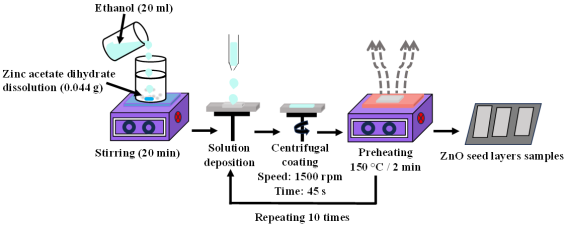
Figure 1. Schematic illustration of ZnO seed layers spin coated.
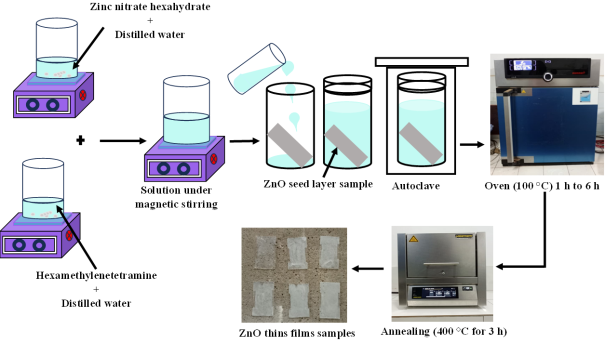
Figure 2. Schematic illustration of the hydrothermal growth process of ZnO thin films.
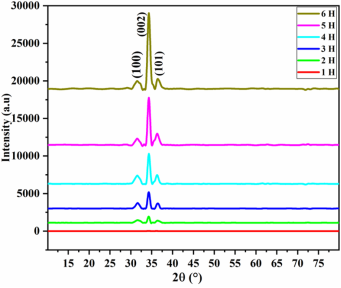
Figure 3. XRD patterns of ZnO thin films synthesized at different growth times.
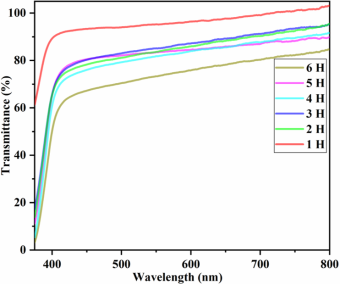
Figure 4. Transmission spectra of thin ZnO films synthesized at different growth times.
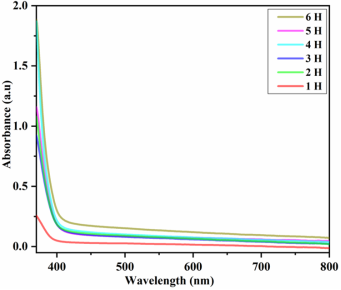
Figure 5. Absorption spectra of ZnO thin films synthesized at different growth times.
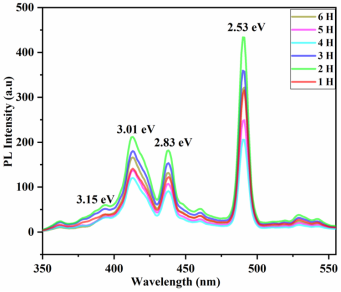
Figure 6. Photoluminescence spectra of ZnO thin films synthesized at different growth times.
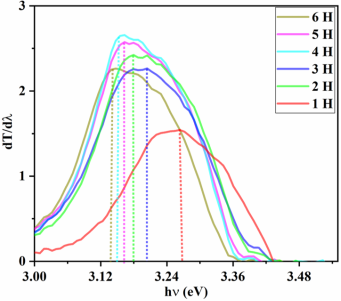
Figure 7. dT/dλ curve as a function of photon energy for ZnO thin films prepared at different growth times.

Information


 Share This Article
 Twitter
 Linked In
 Facebook
 Copy
Copy Download